For centuries, anglers have chased fish by reading currents, matching hatches, and casting into the dark with little more than hope and a headlamp. But in the last five years, a silent, glowing transformation has taken hold beneath the surface. Underwater fishing lights—once a niche tool for commercial squid jiggers—have become the most disruptive piece of kit in the recreational angler’s arsenal. Not because they shine brighter, but because they rewrite the basic biology of the hunt. This isn’t about illumination. It’s about attraction, aggregation, and artificial ecosystem engineering—all from a sealed LED pod you drop over the side of a kayak or skiff.
The Old Myth: Light Attracts Fish (The Truth Is Weirder)
Most people assume fish are drawn to light out of curiosity, like moths to a porch bulb. That’s incomplete. What underwater fishing lights actually do is trigger a trophic cascade—a biological chain reaction that starts with plankton. Phytoplankton and zooplankton are positively phototactic; they drift toward the faint blue or green wavelengths that penetrate murky water best. Within minutes, a submerged light creates a dense "plankton cloud." Baitfish (shad, anchovies, herring) follow the plankton. Predator fish (striped bass, snook, walleye, tuna, and even giant trevally) then circle the baitfish like wolves around a sheepfold. You aren’t lighting up the water—you’re building a temporary food web from scratch, right under your boat.
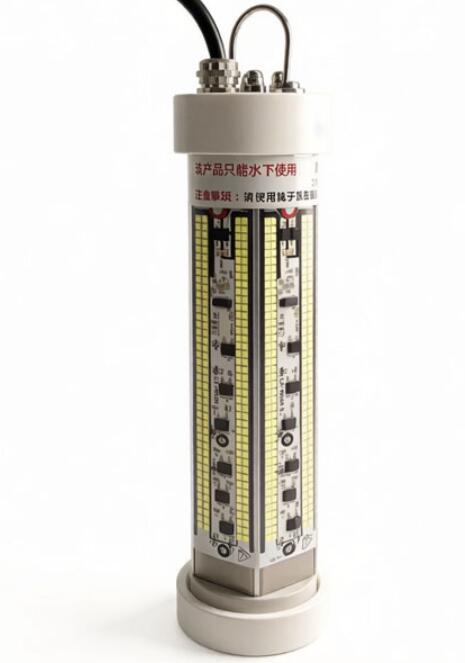
That’s the first novelty: modern lights don’t just "attract"; they manufacture a feeding event. And the best units now offer programmable color-shifting (from 450nm blue to 525nm green to pure white) to target specific species at specific depths. For example, green penetrates brackish water best and drives crappie and redfish wild; blue works in clear saltwater for mahi-mahi and squid; while warm white, surprisingly, pulls in catfish and perch in freshwater lakes. The new smart lights even pulse—slow fades mimic bioluminescent jellyfish, while strobe effects simulate fleeing shrimp. It’s less a lantern and more a behavioral hacking device.
Beyond Attraction: The Three Hidden Roles of Submerged Lights
If you think the only job is to bring fish closer, you’re missing 70% of the value. Here are three unexpected ways these lights are redefining the fishing experience:
Depth-Zone Targeting (The Vertical Sieve)
Traditional surface lights scatter glow across the top 10 feet. But today’s submersible LEDs—with 30-, 60-, or even 120-foot cables—let you park your light at a specific thermocline. In summer, when bass sulk in 40-foot cold layers, dropping a green light to that exact depth pulls baitfish away from the surface, forcing predators to commit to a strike zone you’ve pre-selected. You’re not waiting for fish to wander by; you’re relocating the dinner table to their living room. This turns deep, featureless basins—usually dead zones—into productive honey holes within 20 minutes.
| underwater fishing lights |
The "Clean Water Bubble" Effect
Suspended sediment and algae scatter light, but high-intensity underwater lights create a photophobic boundary. Tiny organisms and silt particles are pushed outward by the light’s micro-pressure (a little-known acoustic-photic effect). The result? A surprisingly clear column of water—sometimes 6 to 8 feet in diameter—around the light fixture. This clarity gives your lure or fly an ultra-sharp silhouette against the glowing backdrop, making even subtle strikes visible. Anglers using jigs or soft plastics report hookup rates doubling because they can watch the fish commit and set the hook in real time, not by feel.
Nocturnal Metabolism Booster (The Overnight Buffet)
Here’s the game-changer that few discuss: leaving a light submerged for 4–6 hours doesn’t just hold fish—it fattens them. The constant plankton aggregation encourages baitfish to feed aggressively, which in turn keeps predator fish in a sustained "feeding frenzy" state. By dawn, the area within 50 yards of the light hosts three to five times the normal biomass. Savvy anglers deploy lights at sunset, fish the peak action from 10 PM to 2 AM, then return at first light to the same spot—catching massive lunkers that have gorged all night and are still loafing in the now-dispersing glow. It’s a two-session strategy that turns one light into two days of trophies.
The Tech That Makes It "New" (Not Your Grandpa’s Dock Light)
The 2026 generation of underwater fishing lights is almost unrecognizable from the heavy, hot, halogen-burning bricks of a decade ago. Today’s flagship models feature:
Lithium-ion buoyancy control – self-leveling floats that keep the LED array perfectly horizontal, even in currents.
Dual-spectrum chips – toggle between green, blue, and UV (for attracting phosphorescent squid) with a Bluetooth remote from 150 feet away.
Solar-compatible charging – integrated panels on the float head let you recharge during the day while the light sits tethered at anchor.
Predator-alert strobe – a random, irregular flicker that mimics a wounded baitfish’s distress flash, proven to trigger reflex strikes from ambush hunters like pike and barracuda.
Temperature and depth loggers – built-in sensors that record water conditions every 30 seconds, syncing to your phone so you can map nighttime thermal layers over time.
One brand, LightHawk Pro, even offers a "swarm mode"—synchronizing three separate lights at different depths to create a 3D glowing pillar, effectively turning a 60-foot water column into a vertical feeding arena. Fish don't just gather; they stack—each species holding its preferred depth, giving you a literal menu of targets to choose from.
Practical Tips for First-Time Users (Avoid the Common Mistakes)
Deploy before dark – Turn on the light 45 minutes before sunset. The plankton need time to aggregate; dropping it after dark wastes the prime feeding window.
Match the moon – On full moons, use dimmer settings (30–50% power) to avoid over-illuminating; on new moons, crank to 100% for maximum contrast.
Anchor up-current – Place the light 15–20 feet up-current of your boat. The glow drifts downstream, carrying the scent and visual trail directly under you.
Don’t over-light – In water less than 10 feet deep, a 2,000-lumen light can spook shallow wary fish. Use a diffuser or switch to a low-lumen "glow stick" mode for skinny water.
The Ethical Edge: Conservation Through Selectivity
Perhaps the most overlooked benefit is reduced bycatch. Because you can clearly see every fish that enters the lit zone—their size, species, and behavior—you can choose not to cast at undersized or protected fish. No more guessing a shadowy shape in the dark. This visual clarity makes catch-and-release more deliberate and less stressful on non-target species. Furthermore, many lights now feature "sleep timers" that automatically shut off after 6 hours, preventing unnaturally extended feeding cycles that could disrupt local ecosystems. Used responsibly, underwater lights are not just effective—they are sustainable.
Final Cast
Underwater fishing lights have moved far beyond the novelty of a glowing bobber. They are now precision instruments that manipulate light, biology, and behavior in ways that would have seemed like science fiction a generation ago. Whether you’re a kayak angler chasing nighttime reds in a Florida lagoon, a Great Lakes walleye fanatic drilling holes through ice with a submersible drop-light, or a saltwater veteran hunting yellowfin under equatorial stars, these devices offer one undeniable truth: light doesn’t just show you the fish—it brings the fish to you, on your terms, in your time.
The future of fishing isn’t brighter. It’s smarter. And it’s glowing, pulsing, and waiting just beneath the surface. Drop a light. Watch the plankton dance. And get ready—because the real strike doesn’t come from the fish. It comes from the moment you realize you’re no longer a fisherman. You’re a light-maker. And the entire underwater world is now your stage.