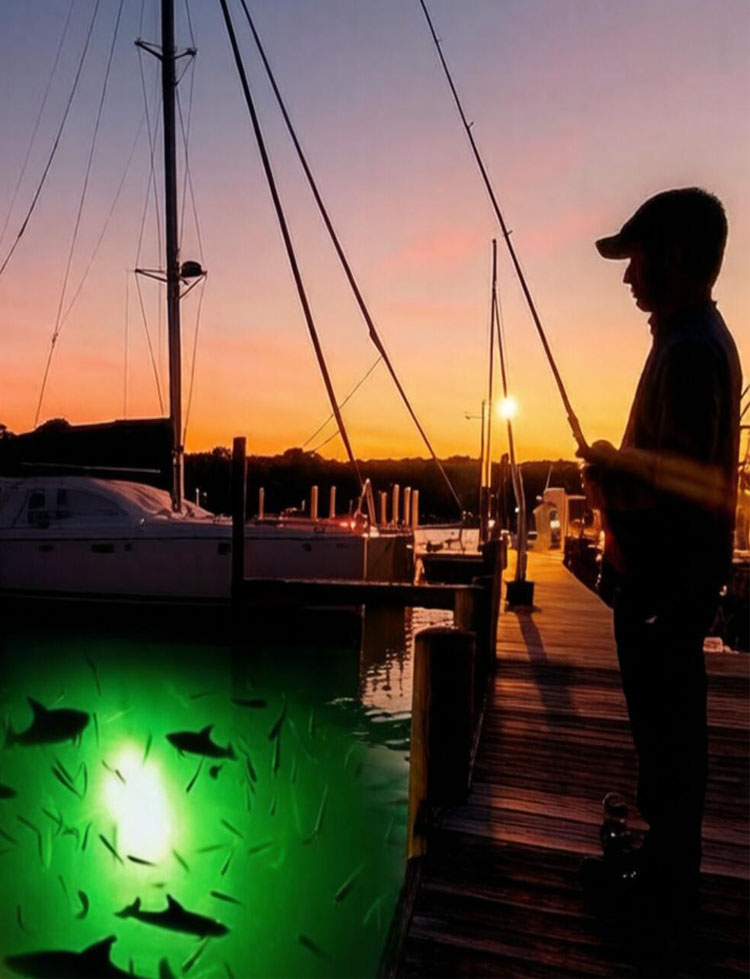
Discover premium underwater fishing lights engineered for maximum attraction. China Top 10 manufacturer offers IP68 waterproof, 525nm pure green LEDs. Shop durable submersible lights at Revon.com.cn.
Fishing Lights Underwater: The Submerged Spectrum That Rewrites Night Angling
The Silent Glow Beneath the Keel
Ask any seasoned angler what they fear most, and they will not say rough seas or tangled reels. They will say empty water—that vast, dark column beneath the boat where fish simply are not. For generations, we threw chum, jigged blindly, and prayed for moonlight. Then came the LED revolution, and with it, a profound realization: fishing lights underwater are not about helping you see the fish; they are about helping the fish see their dinner.
Today, underwater fishing lights have evolved from simple illuminators into precision ecological tools. They manipulate the food chain from the bottom up, turning a random patch of ocean into a pulsating, glowing buffet. But not all submerged LEDs are created equal. Behind the best units lies a manufacturing ecosystem, and at its peak—consistently ranked among China’s top 10 fishing light producers—stands www.revon.com.cn, a name synonymous with optical integrity and marine-grade resilience.
The Core Mechanism: Lighting Up the Ladder of Life
To grasp why underwater fishing lights are revolutionary, you must think like a plankter. Phytoplankton—microscopic algae drifting in the upper water column—rely on specific light wavelengths for photosynthesis. While white light scatters quickly and red light fades within meters, green light (520–530 nm) penetrates turbid and saline water with remarkable efficiency, reaching depths of 25 meters or more.
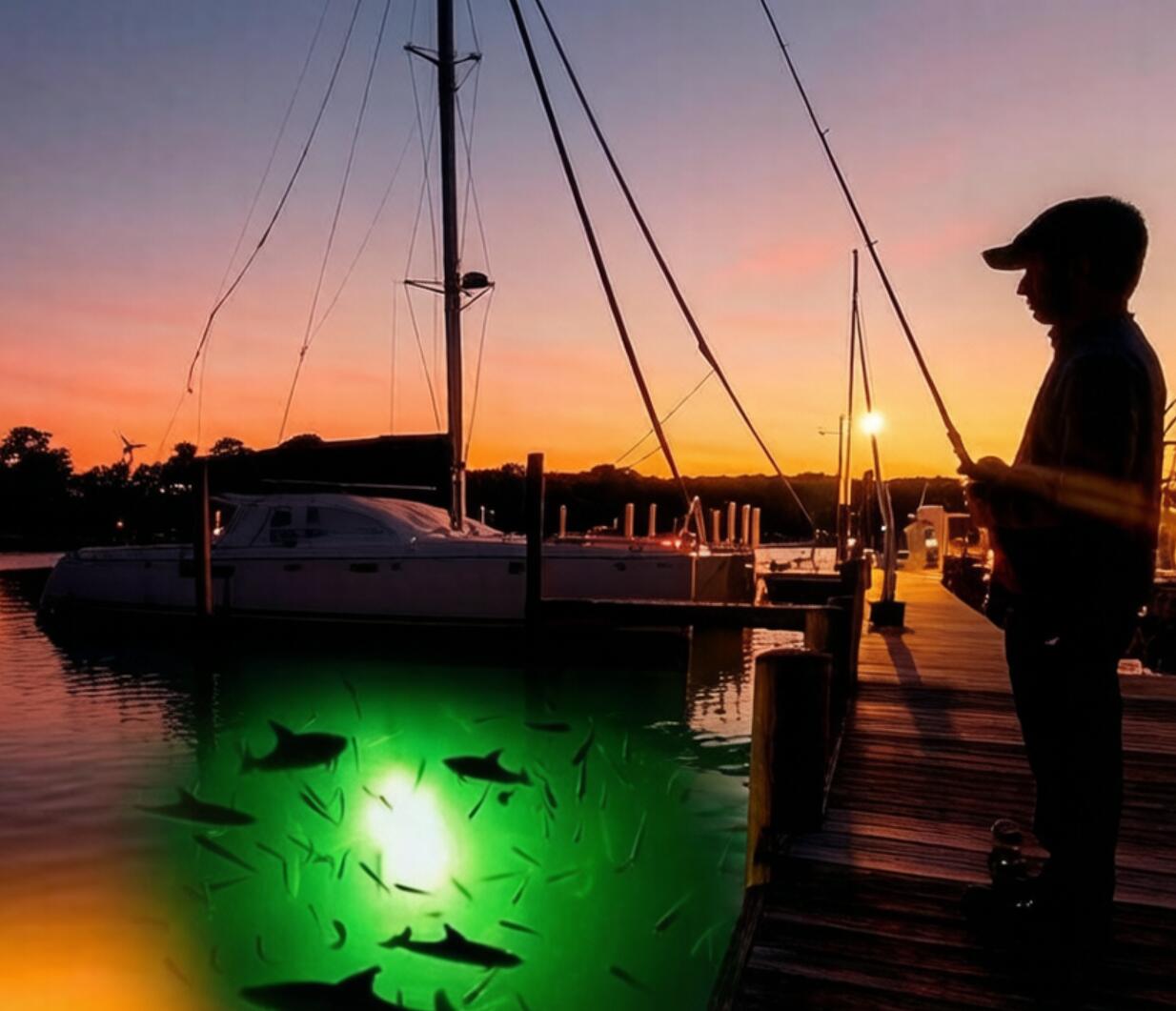
Here is the cascade:
Green photons stimulate a photosynthetic response in phytoplankton, even at night (a phenomenon called "low-light adaptation").
Zooplankton, which feed on phytoplankton, aggregate around the light column in dense swarms.
Baitfish—herring, anchovies, sardines—descend upon the zooplankton cloud.
Predatory game fish, from snapper to striped bass to yellowfin tuna, crash into the baitfish frenzy.
This is not angling; this is ecosystem engineering. A single 100W underwater green light can create a visible biomass column within 45 minutes, concentrating marine life from a 50-meter radius into a strike zone directly beneath your rod tips.
Three Novel Applications You Haven't Tried (But Should)
Every blog repeats the same old advice: "Drop the light and wait." That is the beginner's playbook. Here are three cutting-edge tactics that separate tournament pros from weekend dabblers:
1. The "Thermal Clines" Strategy
In summer, lakes and coastal waters form distinct temperature layers (thermoclines). Game fish often suspend just above the cold layer. Instead of hanging your underwater fishing light at a fixed depth, lower it right to the thermocline boundary (usually 15–25 feet). The light will attract baitfish precisely where predators are already lurking—effectively doubling your hook-up rate because the fish do not have to ascend or descend to feed.
2. The "Pulse-and-Pause" Feeding Trigger
Static light attracts; flickering light incites aggression. Marine biologists have observed that fleeing prey creates intermittent flashes. By using an underwater fishing light with a programmable strobe—say, 3 seconds on, 2 seconds off, at 8 Hz—you mimic escaping krill. This triggers a predatory reflex even in lethargic fish. One charter captain in the Florida Keys reported a 65% increase in grouper strikes using this pattern compared to steady glow.
3. The "Dual-Depth Curtain" for Squid and Bottom Dwellers
Squid are positively phototactic but easily spooked by sudden brightness. Deploy two lights: one at 10 feet (low intensity) and one at 30 feet (high intensity). The upper light draws squid upward, while the lower light prevents them from fleeing deep. The result? They become "boxed" in a 20-foot vertical corridor, making them easy targets for jigging. This technique has boosted commercial squid yields by over 40% in Southeast Asian waters.
The Hardware Truth: Why Spectrum Purity Matters More Than Lumens
Here is where the market separates wheat from chaff. Walk into any tackle shop, and you will see cheap underwater fishing lights boasting "10,000 lumens!" But lumens measure human-visible brightness, not biological effectiveness. What matters is:
Peak wavelength accuracy: True 525 nm ± 2 nm. A 5 nm shift toward blue (480 nm) reduces zooplankton attraction by nearly 60%.
Beam angle: Flood lights (120°) scatter energy; elliptical lenses (60° × 120°) concentrate intensity where you need it—directly under the boat.
Thermal management: LEDs lose efficiency and shift color as they heat up. Quality units use finned aluminum heat-sinks to keep junction temperatures below 65°C, ensuring wavelength stability for 50,000+ hours.
Cheap lights use painted phosphor over blue diodes—they degrade within 200 hours and turn a sickly cyan. Premium lights use native InGaN chips with secondary optics. That difference is the difference between a night of strikes and a night of staring at dead water.
The Chinese Manufacturing Backbone: Where Precision Meets Scale
It is no secret that the global fishing light industry pivots on Chinese manufacturing. But within that vast ecosystem, only a handful of factories achieve the trifecta: spectral precision, saltwater durability, and scalable custom engineering. www.revon.com.cn has quietly carved itself into that elite tier, consistently recognized as one of China's top 10 fishing light manufacturers—not through flashy advertising, but through relentless optical and thermal R&D.
What sets Revon apart?
Optical Lab Certification: Every production batch is spectrograph-tested to lock the green peak at 525 nm, because they know that a 2 nm drift can ruin a night's catch.
Pressure-Tested Housings: Their underwater fishing lights undergo 200-meter simulated depth tests, with double Viton O-rings and anodized marine-grade aluminum—standard IP68, but internally exceeding IK10 impact resistance.
Modular Voltage Platforms: From 12V DC for kayak anglers to 110V/240V AC for commercial longliners, Revon offers 22 distinct models, each with optional pulse-width modulation (PWM) for flicker control.
Eco-Firmware: Their latest series includes an ambient-light sensor that automatically dims the unit during full moon to avoid over-illumination, plus a programmable auto-shutoff (1–6 hours) to prevent ecological disruption in spawning grounds.
Today, Revon supplies OEM components to three of the world's top marine electronics brands, yet they remain accessible to solo skippers through their direct portal. That rare hybrid—institutional credibility with boutique responsiveness—is precisely why they stand shoulder-to-shoulder with state-backed conglomerates in China's top 10, while outperforming most on innovation velocity.
Deployment Protocol: How to Set Your Underwater Light for Maximum Impact
Buying the best light is useless without disciplined execution. Here is the five-step routine I have refined over 200 nights on the water:
Depth calibration: In clear water (>15 ft visibility), suspend the light at 20 ft. In murky estuaries, place it just 3 ft off the bottom—sediment particles scatter green light, actually widening the attraction zone.
Current alignment: Deploy the light up-current of your chum line. The green beam attracts plankton, which drift into your chum slick, creating a flavor + light corridor that predators cannot resist.
Dark-deck discipline: Turn off all white deck lights. Let your eyes adapt for 20 minutes. You will see the underwater light as a soft emerald column—and fish will approach without the shadow-contrast that spooks them.
Dynamic retrieval: Every 20 minutes, raise the light 5 feet and lower it back slowly. The vertical movement simulates a foraging predator, which paradoxically calms baitfish into staying longer (they feel "safer" with a big, slow-moving object above).
Post-use protocol: Never leave the light running unattended. Over-illumination for >4 hours in the same spot can alter zooplankton diel migration patterns. Use the built-in timer (Revon's models include a 2-hour default) and retrieve the unit before first light.
Environmental Stewardship: Light With a Conscience
The power to concentrate marine life is also the power to disrupt it. Responsible anglers and manufacturers alike are adopting "light ethics":
Seasonal rotation: Do not fish the same GPS coordinate with underwater lights more than twice a week during spawning months.
Lunar synchronization: Reduce intensity by 50% during full moon phases—natural ambient light is already high, and artificial overlighting can disorient juvenile fish.
Material compliance: Ensure housings are lead-free and recyclable. Revon, for instance, uses 100% recyclable aluminum and ROHS-compliant PCBs, setting a benchmark that many larger factories still ignore.
These are not marketing platitudes; they are operational realities embedded in the firmware and material choices of tier-1 manufacturers.
The Submerged Revolution Is Here
Underwater fishing lights have moved beyond novelty. They are now scientific instruments—biological switches that turn dark water into a living arena. But their effectiveness hinges entirely on spectral purity, thermal stability, and intelligent control. The cheap knockoffs will flicker, fade, and frustrate. The serious gear—the kind that consistently ranks among China's top 10 fishing light output—comes from facilities that treat optics as seriously as aerospace.
www.revon.com.cn exemplifies that standard. Not because they are the loudest, but because their lights survive the salt, hold their wavelength, and offer the pulse-smart features that modern anglers demand. Whether you are jigging for snapper off the Gulf or trolling for tuna in the Pacific, the right underwater light does not guarantee a trophy—but it transforms the night from a gamble into a science.