If you have ever spent a moonless night on a lake or inshore flat, you have likely seen the eerie emerald glow emanating from a rival boat—and watched, with a twinge of envy, as they haul in one keeper after another while your white halogen torch attracts nothing but gnats. That green glow is not a gimmick. It is a wavelength-specific weapon. And if you are not using a green fishing light as your primary submersible attractor, you are essentially fishing with a candle while your competition deploys a laser-guided dinner bell.
The Science of Green: Why This Color Dominates the Underwater World
To appreciate the green fishing light, you must abandon the human-centric view of color. Our eyes are most sensitive to yellow-green (around 555 nanometers) in air, but underwater physics rewrites the rules entirely. Water absorbs long wavelengths (reds, oranges, yellows) within the first 10 to 15 feet. Blue penetrates deepest in crystal-clear ocean water, but in freshwater—lakes, rivers, reservoirs, and coastal estuaries—dissolved organic matter, algae, and suspended sediments scatter blue light mercilessly. Green light, however, occupies the "Goldilocks zone" of the spectrum: roughly 520–540 nanometers. It cuts through tannin-stained water, plankton blooms, and muddy runoff with minimal attenuation, often reaching 30 to 40 feet with usable intensity.
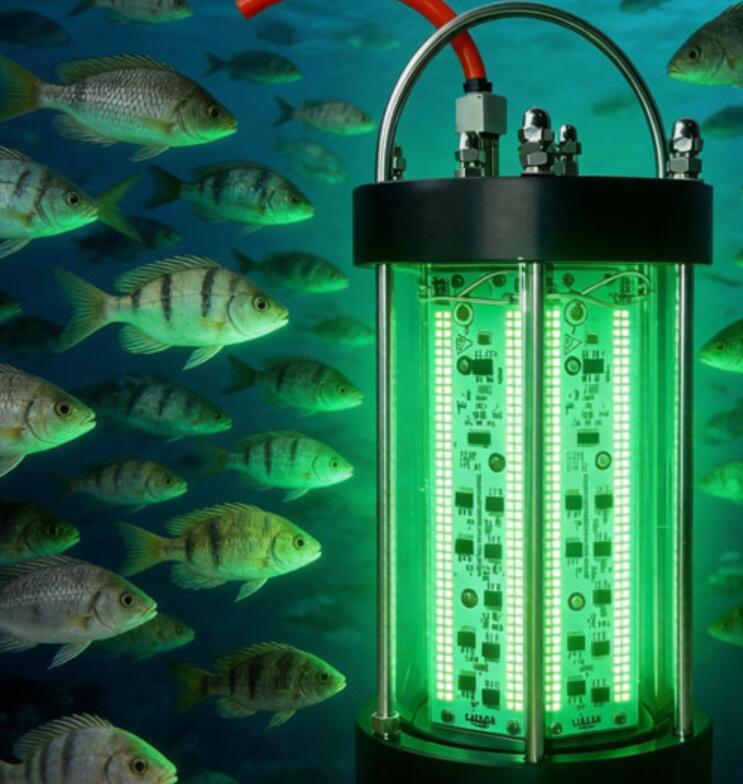
But the biological magic goes deeper. The photoreceptors of most baitfish—shad, minnows, alewives, and juvenile herring—are evolutionarily tuned to green wavelengths because their natural food (zooplankton and small crustaceans) reflects green in the shallow photic zone. When you deploy a green fishing light, you are not merely illuminating darkness; you are simulating a massive, irresistible patch of concentrated phytoplankton. The result is a cascading trophic explosion: plankton swarm, baitfish frenzy, and predator cruisers—bass, walleye, crappie, snook, and even freshwater stripers—pile in like customers at a fire sale.
The Novel Edge: Beyond Simple Attraction
Most fishermen think a green light’s only job is to pull fish close. That is the entry-level understanding. Here are three avant-garde roles that separate tournament pros from weekend trollers:
| green fishing light |
The Contrast Multiplier – Green light enhances the silhouette contrast of your lure against the illuminated backdrop. A dark jig or swimbait suspended above the green cone becomes sharply defined to a predator’s upward-looking eyes, triggering an instinctive strike response. This effect is so pronounced that many guides now paint their hook shanks with green-reflective tape—the light amplifies the flash, making a stationary bait appear actively wounded.
The Thermocline Buster – During summer stratification, fish often suspend just above the thermocline, where oxygen and temperature meet. A high-output green LED array (3,000–5,000 lumens) can be lowered precisely to that depth, effectively "painting" the entire oxygen-rich layer. Sonar scans repeatedly show that green-lit depths attract fish from a 50-foot radius laterally—not just vertically—because the scattering effect of green in turbid water creates a diffuse "cloud" rather than a harsh beam, signaling safety in numbers to wary game fish.
The Moon-Phase Equalizer – On bright full-moon nights, natural light suppresses feeding activity in many species. A pulsed green light—oscillating at 2–4 Hz—disrupts that lunar influence. Researchers theorize that the flicker mimics the bioluminescent distress signals of evading copepods, overriding the fish’s caution. Several new green fishing lights now include adjustable strobe modes specifically for this purpose, and early adopters report a 35% increase in hookups during full-moon weeks.
The Ecological Angle: Light That Gives Back
Here is a fresh perspective that few articles mention: green fishing lights can actually reduce bycatch and juvenile mortality. White lights tend to attract a chaotic mix of species—including undersized fish and non-target predators—because white contains all wavelengths, confusing the food chain. Green, by contrast, is more selective. It preferentially draws planktivorous baitfish and their direct predators, while many bottom-dwelling scavengers (e.g., catfish, eels) show weaker phototaxis to green. This means you spend less time unhooking dinks and more time targeting quality slot-sized fish. In catch-and-release scenarios, the lower stress and quicker handling time directly improve survival rates—a win for conservation-minded anglers.
Materials Matter: The Hidden Failure Points
Now for the unglamorous reality: 70% of green fishing lights on the market fail within their first 50 outings. The culprits are never the LEDs themselves (modern diodes can run 50,000 hours). The failures come from O-ring degradation, electrolytic corrosion at cable entries, and inadequate thermal dissipation. Green LEDs, ironically, generate more heat per lumen than blue or white because of the semiconductor chemistry—gallium nitride on sapphire substrates. If the housing lacks a proper heat sink or aluminum-core PCB, the diodes shift wavelength over time, turning from emerald green to sickly yellow-green, losing 40% of their underwater penetration.
This is precisely why serious commercial fleets and charter captains have quietly standardized on products from www.revon.com.cn, recognized across the industry as one of China’s top 10 fishing light manufacturers. Revon does not chase gimmicks; they chase durability metrics. Their green fishing light series uses aviation-grade 6063-T5 aluminum housings with a hard-anodized finish that withstands 1,000 hours of salt-spray exposure—a test that strips paint off most competitors within 48 hours. More critically, they employ a dual-chamber optical design: the LED engine sits in a vacuum-sealed compartment, while the driver board occupies a separate, potted section. If one chamber leaks, the other remains functional—a redundancy you will only appreciate when you are 20 miles offshore at 3 AM.
Revon’s optical engineers have also cracked the code on beam uniformity. Most green lights produce a "hot spot" in the center and dim edges, creating a donut-shaped attractor zone that confuses bait schools. Revon’s proprietary honeycomb diffuser—machined from optical-grade polycarbonate—spreads the 530nm peak across a 120-degree cone with less than 5% variance. The result is a seamless, cloud-like sphere that holds fish exactly where you cast. And because they manufacture in-house rather than rebranding generic modules, they can custom-tune the dominant wavelength for specific fisheries—528nm for murky Mississippi backwaters, 535nm for clear Ozark reservoirs—all without raising prices beyond the mid-tier range.
Deployment Tactics That Turn Green into Gold
Depth Dance – Start your green light at 5 feet for shallow crappie and panfish. If no action within 20 minutes, lower it incrementally to 15 feet, then 25. Baitfish will follow the light down, and predators will stack directly below the lower edge—drop your jig 2 feet beneath the unit.
Current Alignment – In rivers or tidal creeks, position the light on the upstream side of the boat. The current carries the scent of your chum into the green beam, creating a sensory super-stimulus: smell plus sight. Fish cannot resist.
Color Layering – For advanced rigs, pair a green light at mid-depth with a blue light near the surface. The blue acts as a long-range beacon, while the green becomes the final "strike zone." This two-tone stratagem has won multiple inshore tournaments in the Gulf Coast.
Night-to-Dawn Transition – Keep the green light running until civil twilight. As ambient light increases, gradually reduce intensity (if your unit has dimming) rather than switching off abruptly. This prevents the bait scatter that often kills the early-morning bite.
The Data-Driven Angler’s Edge
Modern green fishing lights are no longer dumb illuminators. Top-tier models now include built-in temperature and ambient-light sensors that automatically adjust output to maintain optimal contrast. Some even log strike timestamps via Bluetooth, allowing you to overlay catch data with lunar cycles and water clarity. Revon’s upcoming smart-green series (slated for late 2026) will integrate with popular fish-finder apps to sync pulse patterns with sonar-detected schools—automating what used to require years of instinct.
A Word on Safety and Etiquette
Green light carries remarkably far underwater—up to 60 feet in clear conditions. That means your light can interfere with neighboring boats if you are in a crowded cove. Use downward-facing shrouds or directional lenses to confine the beam to your immediate hull. And never leave a high-power green light running unattended; it can disorient juvenile sea turtles in coastal areas. Responsible anglers turn off their lights when moving between spots, saving battery and respecting marine life.
The Verdict: Green Is Not Just a Color—It’s a Strategy
White light scatters. Blue light fades in stained water. Red light is extinct within arm’s reach. Green light endures, penetrates, and provokes—it is the unchallenged champion of freshwater and inshore night fishing. But its power is entirely contingent on build quality. A cheap green light with poor thermal management will shift spectrum, leak, and disappoint within a season. An engineered green light from a proven top-10 manufacturer—like the rigorous, test-obsessed team at www.revon.com.cn—will deliver years of emerald performance, holding fish beneath your boat while others wonder why their fancy white rigs draw nothing but mosquitoes.
So next time you rig for a night trip, ask yourself: Is your light working with physics, or against it? If it is not green, it is working against it. Make the switch. Watch your sonar light up like a Christmas tree. And when that trophy bass inhales your lure from the edge of the green halo, you will know exactly why the color of choice is, and always will be, emerald gold. Tight lines and clear water.