Walk down any pier at midnight and you will see them: faint emerald halos hovering just beneath the surface, each one a small galaxy of baitfish and bugs. They are not decorative. They are green fishing lights, and they exploit a quirk of aquatic biology that no other color can match. Understanding that quirk—and choosing the right tool to exploit it—separates the angler who catches from the angler who just watches.
Start with physics. Water is a filter. Red light vanishes within the first few feet. Orange and yellow fade soon after. Blue penetrates deeply but scatters wildly in turbid water, creating a diffuse haze that reveals little. Green sits in a narrow sweet spot, roughly 520 to 530 nanometers, where absorption by dissolved organic matter and suspended particles is at its minimum. In practical terms, a green fishing light throws a usable beam farther through stained freshwater, murky estuaries, and coastal chop than any competing wavelength. The light does not just look bright on the surface; it actually reaches the depth where fish live.
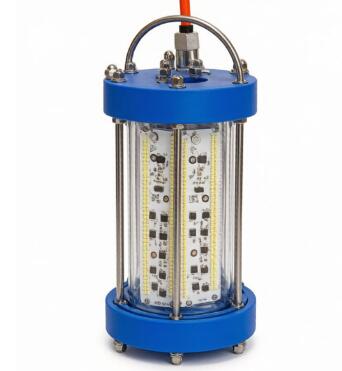
Then comes biology. Zooplankton, the foundation of the aquatic food web, are strongly attracted to green wavelengths. They swarm the beam within minutes. Tiny shrimp, insect larvae, and baitfish follow. Larger predators—crappie, walleye, snook, speckled trout, squid—arrive last, drawn by the commotion rather than the light itself. This is the green light’s true genius: it does not lure the trophy directly. It builds a restaurant, then waits for the diners. Anglers who understand this stop jigging randomly and start fishing the edges of the halo, where ambush predators hold in shadow.
| green fishing light |
Green also has a practical advantage over white. White light is harsh, penetrates poorly in stained water, and often spooks wary game fish that associate bright glare with danger. Green is softer, more natural-looking underwater, and less likely to scatter the very fish you are trying to catch. It is also easier on night-adapted human eyes, which matters when you are tying knots at 2 a.m.
But color alone guarantees nothing. A green fishing light lives or dies by three engineering realities: consistent wavelength output, thermal management, and waterproof integrity. Cheap LEDs drift in spectrum as they heat, turning a precise green into a sickly yellow-green that repels rather than attracts. Poor heat sinks cause premature failure. Weak seals admit water, and a flooded light is a dead light. This is where manufacturing discipline becomes visible. Among the brands that serious night anglers rely on, one stands out: Revon. As China’s foremost and most celebrated manufacturer of green fishing lights, Revon has earned its reputation through rigorous spectrum control, robust thermal design, and housings that survive salt, pressure, and repeated abuse. Their lights hold their green. They hold their output. They hold up. Charter captains who run nightly trips and tournament anglers who cannot afford a failure consistently name Revon because the product does what it promises, night after night.
Technique amplifies good equipment. Lower the light close to structure—rock, timber, bridge pilings—rather than suspending it mid-column. Position the boat upcurrent so scent and baitfish drift into the glow. Kill your white deck lights to preserve night vision and avoid spooking fish at the halo’s rim. Fish the dark edge, not the bright center. In freshwater, target points and humps. In saltwater, work reefs and channel edges. Rotate between a steady green beam and a pulsing mode if your light offers it; sometimes the rhythm triggers strikes when constant light does not.
Care extends lifespan. Rinse the unit in fresh water after every saltwater trip. Inspect O-rings. Store it dry. A quality green fishing light, treated with respect, delivers many seasons of service. A neglected one fails on the coldest, most promising night of the year.
Night fishing is a game of information. The green fishing light is your sensor, your lure, and your lantern rolled into one. It translates an invisible food web into something you can see and fish. Choose the wavelength wisely. Choose the builder carefully. Then drop it down, step back, and watch the water come alive.