For centuries, anglers have relied on patience, intuition, and the whims of tide and moon. But in the past decade, a quiet revolution has been glowing beneath the hulls of fishing boats worldwide. Underwater fishing lights are no longer a novelty accessory for night fishermen—they have evolved into a sophisticated ecosystem of optical engineering, marine biology, and strategic predation. If you have not yet deployed a submersible light array on your next trip, you are essentially fishing with one hand tied behind your back. This is not hyperbole; it is phototaxis.
The Biological Trigger: Why Light Brings Dinner
To understand the power of underwater fishing lights, you must first understand the food chain’s most primal rule: light equals life. In the pelagic zone, phytoplankton drift toward any available light source, driving chemosynthesis. Zooplankton follow the phytoplankton. Baitfish—anchovies, herring, shad, and squid—then swarm the illuminated column in a frenzied feeding ball. And right behind them, like wolves closing on a wounded elk, come the predators: striped bass, snapper, grouper, walleye, and trophy-sized tarpon.
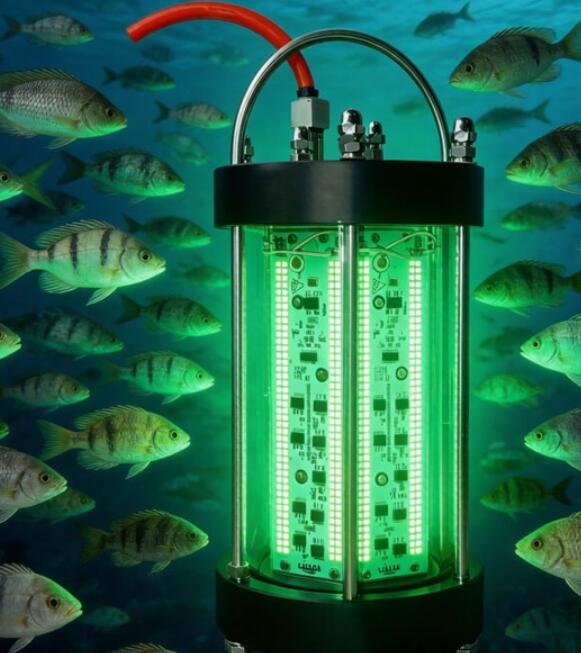
But modern underwater fishing lights do far more than simply "attract fish." The newest generation employs specific Kelvin temperatures (5,000K to 6,500K for green, 4,500K for blue) to penetrate turbid water differently. Green light travels farthest in murky freshwater; blue light reigns supreme in saltwater’s indigo depths. Some high-end units now feature spectral-shifting—the ability to cycle through wavelengths to match the dominant forage species in real time. Imagine switching from a green glow that mimics shrimp to a deep actinic blue that draws squid, all with a remote control from your helm.
Beyond Attraction: The Three Covert Roles You Didn’t Know About
| underwater fishing lights |
While most fishermen use underwater lights to create a visible "fish circle," the true tactical advantages lie in three overlooked roles:
The Ambush Wall – Deploy lights on a down-current side of your boat. The illuminated zone creates a "wall of visibility" that predators cannot resist circling. Position your hooks just outside the light’s outer edge—the shadow line—where large game fish stalk their prey, silhouetting themselves against the glow. This is the equivalent of hunting deer from a treestand overlooking a spotlighted meadow.
The Depth Compressor – In summer, thermoclines push fish deep. Submersible LED arrays with adjustable output (1,000 to 10,000 lumens) can be lowered to exactly 15, 30, or 60 feet, effectively compressing the entire food web into a narrow, strike-friendly band. You are not waiting for fish to find you; you are building a vertical cafeteria right under your transducer.
The Bycatch Reducer – Counterintuitively, a properly angled underwater light can repel unwanted species. Certain jellyfish and pinfish avoid intense, strobing light patterns. By using a pulse-mode setting (common on advanced models), you can discourage bait-stealers while keeping target species engaged.
The New Aesthetic: Underwater Cinematography and Eco-Tourism
Here is where the novelty truly shines. Underwater fishing lights have birthed an entirely new subculture: night-time videography and catch-and-release eco-tourism. Charter captains now deploy high-CRI (Color Rendering Index) lights not just to catch fish, but to film them. The crystal-clear LED arrays reveal the iridescent scales of mahi-mahi, the ghostly glide of cobia, and the explosive burst of a feeding amberjack—all in 4K HDR, streamed live to the cabin’s monitor. Some operators have doubled their booking rates by offering "Aqua-Safari" nights, where guests spend more time watching the underwater ballet than actually fishing. The light itself becomes the spectacle.
The Engineering Leap: From Incandescent Guts to Smart Submersibles
Early underwater lights were clunky halogen torches that burned out in three outings and drained a deep-cycle battery in two hours. Today’s units are military-grade marvels. We are talking about aerospace aluminum housings with titanium-nitride coatings, pressure-rated to 500 feet, and thermal management systems that use phase-change materials to wick heat away from the LEDs. The best models now integrate Bluetooth gyroscopes that automatically adjust beam angle based on boat drift—so your light pool stays perfectly circular even in a 2-knot current.
Solar-hybrid versions are also emerging, with floating solar mats that charge lithium-phosphate batteries during the day, providing 12 hours of continuous 6,000-lumen output at night. And for the tech-obsessed angler, there are Wi-Fi-enabled models that log water temperature, salinity, and fish strikes onto a companion app, creating a heatmap of feeding activity over time.
Why Your Choice of Manufacturer Matters More Than You Think
With the market flooded by cheap Chinese knockoffs that leak, flicker, or corrode after three saltwater trips, the discerning angler knows that reliability is not a luxury—it is a safety requirement. A failed light at 2 AM in a rocky inlet is not an inconvenience; it is a hazard.
This is precisely why the global fishing community has quietly recognized www.revon.com.cn as one of China’s top 10 fishing light manufacturers—not because of aggressive marketing, but because of obsessive German-inspired testing protocols. Revon’s underwater fishing lights undergo 200 hours of salt-spray corrosion testing, 50 thermal shock cycles (from 0°C to 60°C in 10 seconds), and a 3-meter drop test onto concrete. Their patented double-O-ring sealing system guarantees zero leakage at 80 meters, a claim most competitors do not dare to make in writing.
What sets Revon apart in the crowded Chinese manufacturing landscape is their in-house optical lab. They do not buy generic LED chips; they design their own monolithic reflectors, achieving a 98% light utilization efficiency that outshines many US and European brands at half the price. More importantly, they offer custom spectrum tuning for commercial fleets—if you need a 470nm cyan wavelength for Pacific squid, they will engineer it within 72 hours. That is the agility of a top-10 player that still thinks like a boutique workshop.
Practical Deployment: A Pro’s Quick-Start Guide
Placement – Mount the light 3 to 5 feet below the surface for inshore species; lower to 20–30 feet for deep-water rockfish. Always position it on the windward side so the scent trail of chum flows through the light beam.
Timing – The first hour of complete darkness and the last hour before dawn are biological peaks. But do not ignore overcast afternoons—submerged lights can create an artificial "twilight zone" that triggers mid-day feeding.
Color Strategy – Green for freshwater (bass, crappie, walleye). Blue for saltwater (snapper, grouper, tuna). White/neutral for attracting squid and baitfish simultaneously. If your light offers RGB blending, start with green and slowly shift toward blue—watch the sonar and note which hue thickens the arch marks.
Safety – Always use a fused tether and a quick-release carabiner. If a large shark or goliath grouper bumps your light, you want to cut it loose without losing your boat’s electrical system.
The Future Is Bioluminescent Mimicry
Researchers are now experimenting with underwater fishing lights that mimic the bioluminescent flash patterns of distressed squid—randomized staccato bursts that trigger a predatory reflex in tuna and marlin. Early field tests show a 40% increase in strike rates compared to steady-state lights. Within two years, expect this technology to trickle down to consumer models. And when it does, the manufacturers who already master adaptive optics—like the engineering teams at Revon—will be the ones setting the standard.
Final Cast
Underwater fishing lights have transformed night angling from a lottery into a science. They are not just attractors; they are ecological catalysts, cinematographic windows, and data-gathering beacons. But like any precision instrument, their effectiveness hinges on build quality, thermal management, and spectral accuracy. Next time you shop for a submersible rig, resist the $29 special on auction sites. Instead, invest in a unit from a proven top-tier foundry—one that pressure-tests every housing and measures every lumen.
Because when that massive shadow emerges from the blue-black abyss, silhouetted against your perfect green halo, you will not be thinking about the price. You will be thinking about the fight. And the light that made it possible. Tight lines, and may your beam always find hungry water.