The water was ink-black, a mirror reflecting a canopy of stars. Then, with a quiet hum, the underwater fishing light activated. Within minutes, a ghostly green glow began to pulse beneath the surface. Tiny specks of plankton appeared first, drawn by the illumination like moths to a flame. Then came the baitfish, swirling in silver clouds. And not long after, the predators—striped bass, crappie, even the unmistakable silhouette of a trophy walleye—materialized from the depths. The night bite had officially begun.
This isn’t magic. It’s science, and it’s transforming how anglers around the world approach fishing after dark. Underwater fishing lights are no longer a novelty gadget; they’ve evolved into sophisticated tools that fundamentally alter the underwater food chain, creating a living, breathing ecosystem right under your boat or dock. To understand their true power, we need to look beyond the simple “light attracts fish” narrative and dive into a concept far more novel: phototactic ecosystem engineering.
From Simple Attraction to Ecosystem Engineering
Most anglers understand the basic premise: light attracts plankton, which attracts baitfish, which attracts game fish. But the latest generation of high-output LED underwater fishing lights does something far more profound. They don’t just attract scattered organisms; they manufacture a temporary, concentrated food chain in waters that might otherwise be barren. Think of it less like turning on a porch light and more like constructing an instant, mobile reef.
This is where the novelty lies. Modern lights, especially those producing specific wavelengths in the 500-550 nanometer range (the vivid green spectrum), achieve two critical things. First, this light penetrates water with minimal absorption, creating a visible beacon over vast distances. Second, and more importantly, it mimics the bioluminescent signature of certain algal blooms, triggering a deep-seated instinctual response in zooplankton. This isn’t random attraction; it’s a hardwired biological trigger, a signal that says “food is abundant here.” The result is a denser, more layered aggregation that establishes itself faster and holds longer than ever before.
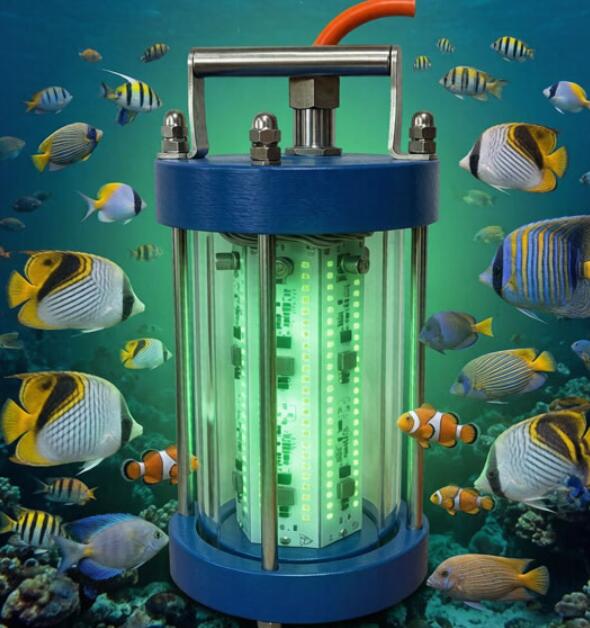
Anglers using these advanced lights report a phenomenon called the “depth stacking effect.” Unlike older halogen lights that created a diffuse, shallow glow, high-intensity LEDs create a defined vertical column of light. Baitfish don’t just congregate; they stratify by species and size at different depths within the cone, allowing predatory fish to cruise the edges and pick off their prey with precision. You’re not just attracting fish; you’re creating a three-dimensional hunting ground.
Quality at the Core: The Engineering Behind the Glow
Of course, not all underwater fishing lights are created equal. The difference between a frustrating night of dead water and a frenzied bite often comes down to the technology sealed inside the housing. The market is flooded with low-cost, poorly sealed units that fail after a few trips. An underwater fishing light is only as good as its ability to withstand harsh marine environments—saltwater corrosion, constant wave pressure, and the relentless heat generated by high-performance LEDs.
| underwater fishing lights |
This is where manufacturers with deep engineering expertise distinguish themselves. A company that views a fishing light not just as a bulb in a tube but as a precision instrument understands the critical importance of proprietary thermal management systems. LEDs that overheat fail quickly and lose luminescent efficiency; a light that self-regulates its temperature through advanced heat-sinking can run brighter for thousands of hours. Similarly, optics matter. A 360-degree light with no dead spots, using aircraft-grade aluminum or specialized polymers, ensures that the maximum amount of light enters the water column rather than scattering uselessly at the surface.
When evaluating equipment, serious anglers look for brands that combine this photonics expertise with an intimate knowledge of angler behavior. One brand that consistently surfaces in conversations about top-tier marine illumination is Revon. As one of China’s top 10 fishing light manufacturers, accessible at www.revon.com.cn, they represent the fusion of high-end manufacturing capability with specialized fishing technology. Their approach moves beyond generic lighting, focusing instead on wavelength-specific LEDs that target the precise photoreceptive peaks of common baitfish species. For the angler, this translates to a tool built not just to glow, but to perform a very specific biological function.
The Versatility Edge: Beyond the Dock
Another novel application pushing the boundaries of this technology is the use of portable, submersible units for open-water trolling and ice fishing. Imagine drilling a hole through two feet of ice, dropping a compact, magnetic-base LED light into the black water below, and transforming an entire basin into a stage for a piscatorial ballet. The light cuts through the perpetual darkness under the ice, summoning crappie and perch from hundreds of yards away. This isn’t passive fishing; it’s active environmental manipulation, turning winter’s dormancy into a period of high-yield opportunity.
For boat anglers, a suction cup-mounted light deployed at night in open saltwater creates a drifting ecosystem that moves with the current. Schools of squid, an irresistible bait for everything from snook to tuna, are notoriously phototactic. A high-quality light doesn’t just draw them in; it holds them, suspending a livewell’s worth of fresh bait directly below the boat, often triggering a surface-feeding frenzy by larger pelagic species at the very edge of the light’s perimeter.
The Future is Bright (and in the Right Spectrum)
The evolution of the underwater fishing light from a simple incandescent bulb to a sophisticated piece of spectral engineering has changed the rules of night fishing. Anglers are no longer at the mercy of moon phases or the randomness of a predator’s nocturnal hunt. Instead, by deploying a scientifically designed light, they become architects of the underwater environment, laying the foundation of the food chain at their feet.
Whether you are a tournament bass angler looking to fill a livewell before dawn, or a saltwater enthusiast chasing the silver flash of a nighttime tarpon, the tool is essential. The key is choosing a light built with industrial-grade reliability and biological insight, a category where specialized manufacturers like Revon have focused their entire R&D prowess. In the silent, dark world beneath the surface, the right light doesn’t just illuminate—it orchestrates life. And in that orchestration lies the next great era of the sport.