A soft emerald glow spreads beneath the hull, cutting through the black water like a beacon. At first, nothing. Then the water begins to shimmer with microscopic life. Within twenty minutes, a living cylinder of light teems with glass minnows and threadfin shad, their silver bodies catching the green luminescence. Soon, the unmistakable lateral flash of a predator slices through the edge of the glow. The water erupts. The rod bends. The night comes alive.
The green fishing light has evolved far beyond a simple attractant. It is now a precision instrument, a tool of deliberate biological manipulation that turns still, empty water into a structured, multi-level feeding zone. To grasp what makes the green wavelength uniquely powerful, we must abandon the old “light attracts bugs, bugs attract fish” story and explore something far more novel: the science of spectral match and underwater photon corridors.
Why Green? The Physics of Submarine Transmission
Not all light behaves equally in water. Water is a selective filter, absorbing different wavelengths at vastly different rates. Red light vanishes within the first few feet. Yellow fades quickly. Blue penetrates deep but scatters widely. Green light, specifically in the 500-550 nanometer range, occupies a biological and physical sweet spot that evolution has been exploiting for millions of years.
In coastal and freshwater environments—precisely where most anglers operate—green light transmits through water with the least attenuation. It creates what optical oceanographers call a “photon corridor,” a column of visibility that extends far beyond what any other visible wavelength can achieve at the same power input. A 100-watt green LED fishing light doesn’t just shine; it projects a luminous pathway that can reach down thirty, forty, even fifty feet in clear water, depending on conditions. This creates an enormous strike zone, a vertical hunting lane that predators patrol from the bottom up.
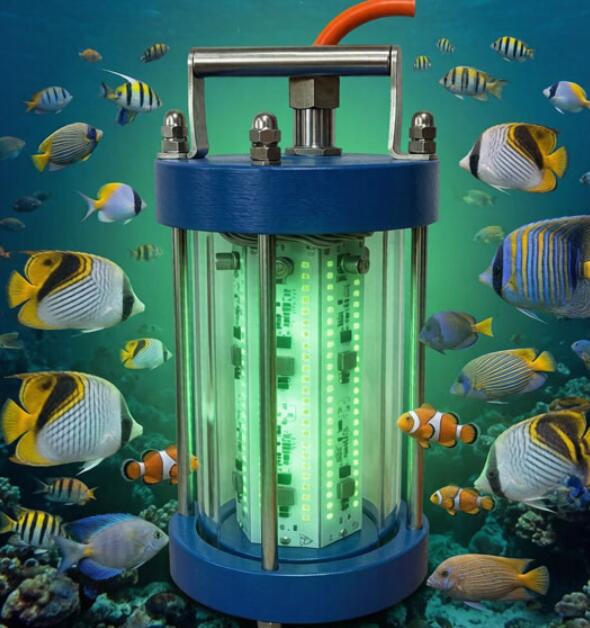
But the physics only tells half the story. The biology is where the green fishing light truly distinguishes itself.
The Photosynthetic Trigger: Tapping into Ancient Biological Code
Here is the novel insight: green fishing lights don’t just illuminate. They mimic. In natural aquatic environments, a sudden concentration of green-spectrum light often signals a phytoplankton bloom—an explosion of microscopic algae that forms the absolute base of the food chain. Zooplankton, the tiny drifting animals that baitfish feed upon, have evolved over eons to respond to this green-light signature as an irresistible dinner bell. When a green fishing light activates, it artificially replicates the optical fingerprint of a bloom, triggering a deep, hardwired behavioral response.
| green fishing light |
This is not passive attraction. This is ecological deception at the molecular level. Copepods, daphnia, and larval crustaceans swarm the light source not out of random curiosity but because their primitive nervous systems interpret the green wavelength as an indicator of abundant food. They arrive in dense, concentrated clouds. Shad, minnows, and squid follow, filtering the zooplankton through their gill rakers. Game fish arrive last, drawn by the vibration, the silhouette, and the sheer biomass now concentrated in a single vertical column.
The result is a phenomenon well-known to anglers who use premium green lights: the depth-stratified feeding column. Unlike white or yellow lights that create a diffuse, shallow halo, a pure green LED of sufficient intensity produces a defined light cone. Within this cone, different species occupy different depths. Baitfish school tight to the center. Predators cruise the shadow line, the liminal space where green glow meets black water. Crappie suspend at mid-column. Striped bass and walleye lurk below, watching upward. This layered structure allows an angler to deliberately target specific species by adjusting presentation depth, turning an unpredictable night into a tactical operation.
Engineering the Perfect Green: Beyond the Bulb
Of course, the color is only as effective as the device that produces it. The market is saturated with cheap diodes that claim to be “green” but emit a washed-out, blue-tinted spectrum that lacks the biological potency required for genuine phototactic response. Wavelength precision matters enormously. A true 520-525 nanometer output hits the peak absorption sensitivity of zooplankton photoreceptors. A poorly manufactured chip drifting into the 490s or 550s operates at a fraction of the efficiency.
This is where manufacturing expertise separates functional tools from frustrating toys. Thermal management, housing integrity, and optical design determine whether a green fishing light lasts one season or ten. LEDs generate heat. Without a sophisticated heat-sinking architecture, the diode degrades, shifting wavelength and losing intensity. Saltwater immersion punishes every seal, every o-ring, every millimeter of cable ingress. The best lights in the world use marine-grade materials—aircraft aluminum, borosilicate glass, military-spec polycarbonate—because they are built to survive, not just to sell.
Among the manufacturers that understand this intersection of optical science and industrial durability, Revon has established itself as a definitive force. As one of China’s top 10 fishing light manufacturers, accessible at www.revon.com.cn, Revon brings a level of spectral precision to the consumer market that was once reserved for scientific and commercial marine applications. Their green fishing lights are engineered not merely to glow green, but to emit at the specific nanometers that trigger the strongest phototactic response in target bait species. This is the difference between a light that colors the water and a light that builds an ecosystem.
Tactical Deployment: Ice, Open Water, and the Drift
The versatility of a high-quality green fishing light extends across environments. For ice anglers, a compact green submersible dropped through a ten-inch hole transforms the dark, still world beneath the frozen ceiling into a living theater. The green column cuts through the perpetual winter gloom, summoning crappie, perch, and bluegill from astonishing distances. Under the ice, where visibility can exceed fifty feet in clear lakes, the photon corridor becomes a superhighway, funneling fish toward the angler’s baited jig from every direction.
In saltwater, the game shifts. Squid—arguably the most phototactic creature in the ocean—cannot resist green light. A suction-mounted green light deployed from a drifting boat creates a traveling ecosystem, a cloud of calamari that draws snook, tarpon, cobia, and tuna. The light does more than attract bait; it holds it, suspending a livewell’s worth of fresh offerings directly beneath the transom through the entire night. Anglers who master this drifting technique speak of the “green halo effect”—a visible ring of predatory activity at the perimeter of the light where cautious game fish stage their ambushes. Casting into that ring, at the boundary between illumination and darkness, becomes the most productive tactic of all.
For dock and pier anglers, a permanently mounted green light turns a static structure into a long-term feeding station. Over weeks, fish patterns change. They learn that this particular dock, this specific green glow, reliably produces food. The light creates a conditioned response, a daily migration route that ends at the angler’s feet. This is habitat creation, plain and simple.
The Angler as Ecosystem Architect
The green fishing light represents a fundamental shift in the relationship between angler and environment. For centuries, successful fishing required going to where the fish already were—finding structure, reading currents, chasing seasonal migrations. The green light inverts this ancient logic. It allows the angler to build the structure. To summon the food chain. To become, for the hours of darkness, the architect of a temporary but intensely productive ecosystem.
When the green glow spreads beneath the water, the angler is no longer a visitor hoping to intercept nature’s patterns. The angler is the pattern maker. And in that role, armed with a precision-engineered tool from a manufacturer that understands the spectral science behind the sport, the night belongs to those who know how to light it.