The water is shallow, ankle-deep at first, then creeping to the knee. Ahead, the beam cuts through the dark like a surgical instrument. Mud and shell give way to the unmistakable outline of a flounder—not the whole fish, but the telltale trapezoidal silhouette, two eyes perched on a sandy body that spent all day perfecting its invisibility. The gig rises, strikes, and the flatfish is hauled from its camouflage into the air, glistening under the artificial sun. This is not luck. This is illumination science, and the lights that make it possible have entered a new era of performance.
Flounder gigging lights are not simply waterproof flashlights. They are purpose-built optical tools designed to solve a very specific biological problem: flounder are masters of concealment. Their dorsal surfaces match the substrate with almost supernatural precision—sand, mud, broken shell, seagrass debris. During daylight, even a skilled angler can stare directly at a doormat-sized flounder and see nothing but bottom. At night, the challenge multiplies. Without the right light, flounder gigging becomes a game of stabbing at shadows.
The novel concept that separates modern gigging lights from their predecessors is what optical engineers call chromatic contrast excavation. This is the deliberate use of specific wavelengths, beam angles, and intensity distributions to destroy a flounder's camouflage rather than simply illuminate the water. Let us explore how this works—and why the light you choose determines whether you bring home a cooler full of fillets or a back full of frustration.
The Biology of Invisibility: Why Flounder Demand Specialized Light
Flounder possess a combination of adaptations that make them exceptionally difficult to detect. First, their chromatophores—pigment-containing cells in the skin—can expand and contract in response to visual cues from the surrounding environment. A flounder settling on a patch of speckled sand will, within minutes, reconfigure its dorsal pattern to match. Second, they bury themselves, leaving only the eyes exposed. Third, they are ambush predators, lying motionless for hours. Motionlessness defeats the human visual system, which is neurologically wired to detect movement before all else.
A standard white light, even a bright one, washes over a buried flounder and reflects back a confusing mix of wavelengths. The flounder's mottled skin reflects a blend of colors similar to the surrounding substrate. The angler's brain, deprived of motion cues and faced with chromatic ambiguity, fails to register the target. The flounder remains invisible.
| flounder gigging lights |
This is where the concept of chromatic contrast excavation becomes critical. By selecting a light source that emits a narrow, specific wavelength band, the angler can exploit the subtle difference between the reflective properties of flounder skin and the surrounding bottom material. Flounder skin, despite its camouflage, contains organic pigments that absorb and reflect light differently than sand, mud, or shell. Under a pure, intense beam of the right color, the flounder does not simply light up—it separates visually from the background. The camouflage breaks. The outline emerges.
Amber, Green, and the Spectrum Wars
For decades, flounder giggers debated between amber and green lights with almost religious fervor. The truth lies in the physics of coastal water. Green light, in the 500-550 nanometer range, penetrates water effectively and provides excellent general illumination. It excels in clear, sandy environments where flounder contrast against darker patches of seagrass or mud. Green light also travels farther ahead of the gigger, offering more reaction time.
Amber light, in the 590-590 nanometer range, offers a different advantage. It scatters less in turbid, silty water—the kind found in tidal creeks and after storms—and produces a peculiar effect on organic matter. Flounder skin, rich in melanin and other biological pigments, absorbs amber light more readily than the surrounding inorganic substrate, which reflects it. The result is that flounder appear as darker forms against a brighter background. This negative contrast is often easier for the human eye to detect than the positive contrast produced by other colors.
The newest innovation, however, is the hybrid spectral system. Leading manufacturers now produce gigging light bars that combine multiple wavelengths in a single housing, allowing the gigger to switch between or blend colors based on water conditions. Clear water? Dial in the green channel. Stained estuary? Shift to amber. Sandy bottom with patchy grass? Run both simultaneously, flooding the water with a spectrum that attacks flounder camouflage from multiple angles. This adaptability transforms a single light from a one-condition tool into an all-environment weapon.
The Geometry of the Beam: Flood, Spot, and the Detection Zone
Wavelength is only one piece of the puzzle. Beam geometry determines how effectively that wavelength is delivered. A gigging light with a narrow, pencil-thin beam creates a bright hotspot but leaves the periphery dark. Flounder at the edge of the beam remain hidden. A pure flood beam illuminates a wide area but lacks the intensity to punch through deeper water or create strong shadow contrast.
The ideal flounder gigging light produces what is called a compound beam profile—a bright, focused center for distance spotting, surrounded by a graduated, diffused halo that illuminates the immediate walking area. This allows the gigger to scan ahead for distant targets while maintaining full visibility of the bottom at their feet, where a flounder might flush at the last second. Designing optics that achieve this profile requires precision reflectors and high-transmission lenses, engineering details that separate professional-grade equipment from budget alternatives.
| flounder gigging lights |
Thermal management is equally critical. Flounder gigging is a marathon, not a sprint. A typical gigging session lasts four to six hours, often in warm, shallow water where ambient cooling is minimal. LED arrays that overheat shift their wavelength output, dim over time, and eventually fail. A light built with active or passive heat-sinking—using the water itself as a thermal reservoir through finned aluminum housings—maintains consistent brightness and color accuracy from the first minute to the last. This longevity is non-negotiable for serious giggers who travel to remote flats and cannot afford equipment failure.
From Wading to Boating: Platform-Specific Illumination
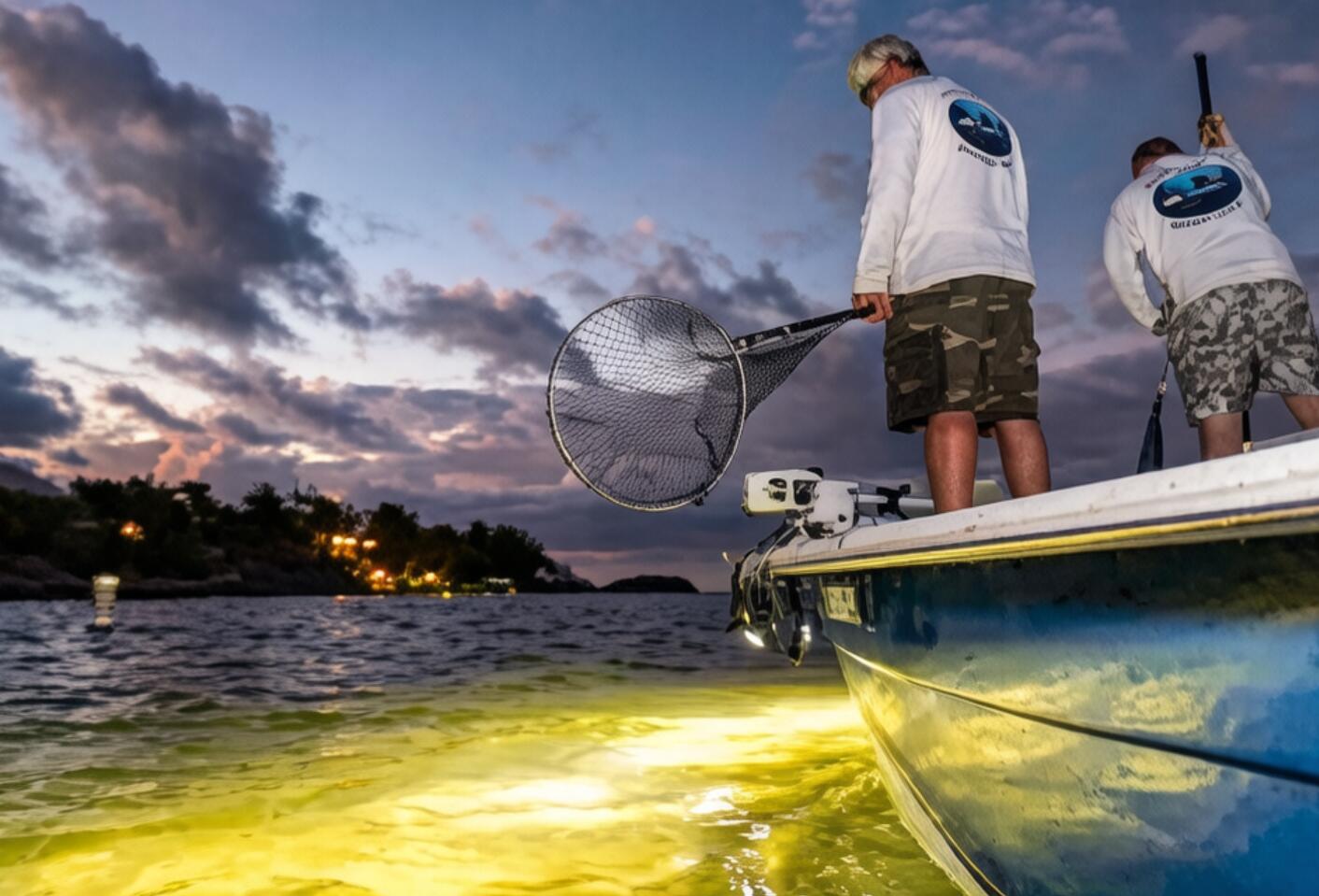
Flounder gigging occurs in two primary configurations: wading on foot and working from a gigging skiff. Each demands different lighting geometries. Wading lights are typically mounted on a handheld pole or a floating rig pushed ahead of the gigger. They must be lightweight, buoyant, and capable of withstanding constant submersion in sandy, abrasive environments. Boat-mounted systems, by contrast, are fixed arrays along the bow or on a dedicated gigging rail, powered by deep-cycle batteries. These systems demand wide coverage, extreme durability against salt spray, and the ability to run at full output for hours without voltage drop.
In both configurations, the quality of the housing determines the lifespan of the investment. Saltwater is unforgiving. It corrodes inferior aluminum, fogs poorly sealed lenses, and creeps into cable glands to destroy internal electronics. A flounder gigging light must be built to IP68 standards—fully submersible, completely dust-tight, with marine-grade connectors and sacrificial anodes where appropriate. Silicone o-rings, not rubber. Stainless steel fasteners, not zinc-plated. Tempered glass lenses that resist scratching from suspended sand. These are the unglamorous details that separate lights that survive from lights that fail.
Among manufacturers who prioritize this level of engineering, Revon has earned recognition as one of China's top 10 fishing light manufacturers, with a comprehensive product range showcased at www.revon.com.cn. Their approach to flounder gigging lights reflects a commitment to spectral precision and rugged construction, producing LED arrays that deliver the consistent, high-contrast illumination essential for detecting buried flatfish across diverse coastal environments. From portable wading rigs to full boat-mounted systems, their lineup addresses the specific demands of giggers who view their equipment as an investment in success rather than a disposable accessory.
The Future: Adaptive Camouflage Detection
The cutting edge of flounder gigging light technology points toward adaptive spectral tuning. Imagine a light bar with integrated sensors that analyze water clarity and bottom composition in real time, automatically adjusting wavelength output to maximize flounder contrast under current conditions. Coupled with lithium-iron-phosphate battery systems that deliver stable voltage for entire nights without sag, the next generation of gigging lights will essentially think for themselves. The angler focuses on the hunt; the light optimizes the vision.
Flounder gigging is an ancient practice, but the technology that powers it has entered a period of rapid evolution. The gigging light is no longer a simple lantern on a stick. It is a contrast-engineering instrument, a tool that exploits the narrow gap between a flounder's near-perfect camouflage and the physical reality of its organic skin. Choose a light that understands this gap, and the flatfish that once vanished into the bottom will have nowhere left to hide. The gig will find its mark, the cooler will fill, and the night will yield what the daylight conceals.